What to Look for in a Threat Intelligence Tool
Most security teams aren't short of data. The harder problem is turning that data into intelligence they can act on. This guide sets out the seven criteria that separate an effective threat intelligence tool from another unused dashboard: dark web coverage, relevance, human analysis, speed, multi-audience outputs, integration and provider trust. It also covers the red flags to watch for during procurement and gives ten questions to ask every vendor.
.png)
The best threat intelligence tool is not the one with the most data. It is the one that tells your team what matters, why it matters, and what to do next, before an attacker makes the decision for you.
Most security teams are not short of information. They are drowning in it. Feeds, alerts, IOCs, dark web chatter and vendor reports pour in faster than any analyst can read them. The result is alert fatigue, missed signals and a growing gap between what the tool collects and what the business can act on.
Choosing a threat intelligence tool is really a decision about where your analysts spend their time. Get it right and intelligence becomes a force multiplier across your SOC, incident response, fraud and executive teams. Get it wrong and you have bought another dashboard nobody opens.
Here is what to look for, the red flags to avoid, and the questions that separate genuine intelligence from repackaged noise.
Seven things that actually matter
1. Coverage that goes where attackers go
Threats rarely announce themselves on the open web first. Ransomware groups post victims on leak sites, initial access brokers sell credentials on forums, and campaigns are coordinated in closed Telegram channels. Look for a tool that monitors the open, deep and dark web, paste sites, messaging platforms and leak sites, not just public OSINT feeds that everyone else already has.
Breadth alone is not enough, though. Ask how sources are accessed, maintained and vetted. A source that went dark six months ago is worth nothing.
2. Relevance to your organisation
Generic intelligence creates generic work. A strong platform lets you define what matters to you: your brands, domains, executives, suppliers, sector and geography. It should then filter and prioritise everything against that profile, so your team sees the credential leak naming your company before the industry-wide ransomware roundup.
3. Human analysis, not just automation
Automation is essential for scale. But a machine can tell you that something happened; an experienced analyst can tell you what it means. The difference shows up in the details: attribution, motive, likely next steps and the confidence behind each judgement.
Look for intelligence that is written, assessed and contextualised by people who understand threat actors, geopolitics and your industry. If every item reads like a raw scrape, you are doing the analysis yourself.
4. Speed that matches the threat
Intelligence has a shelf life. A leaked credential is most dangerous in the first hours after it appears. A tool should alert in near real time on high-priority findings, with clear severity so your team knows what needs action now and what can wait for the weekly brief.
5. Actionable outputs for every audience
Your SOC needs IOCs and TTPs mapped to frameworks such as MITRE ATT&CK. Your CISO needs a risk summary. Your board needs to know whether a geopolitical event changes the threat picture. Good intelligence serves all three, at tactical, operational and strategic level, without forcing analysts to rewrite everything for each audience.
6. Integration with how you already work
Intelligence locked in a separate portal gets ignored. Look for API access, STIX/TAXII support and integrations with your SIEM, SOAR, TIP and ticketing tools, so intelligence flows into the workflows where decisions are made.
7. A provider you can trust with your data
A threat intelligence provider knows what you are worried about, which assets matter most and where you are exposed. That makes them part of your attack surface. Check for recognised certifications such as ISO 27001:2022, clear data handling practices and a track record of ethical, lawful collection.
Red flags to watch for
- Volume as the headline metric. "Millions of IOCs" sounds impressive until your team has to triage them. Ask how much of it is relevant to you.
- No humans in the loop. If nobody can explain how an assessment was reached, you cannot defend the decisions you make on it.
- One-size-fits-all reporting. If a retailer and a defence contractor receive the same output, neither is getting intelligence.
- Vague answers about sources. Credible providers can explain their collection approach without compromising it.
- A demo that only shows the dashboard. Ask to see real intelligence on your own organisation or sector, not a polished sample.
Ten questions to ask every vendor
Take these into your next evaluation. The answers will tell you more than any feature list.
- Which sources do you monitor, and how do you maintain access to closed communities?
- How do you tailor intelligence to our brands, assets, suppliers and sector?
- Who writes your assessments, and what experience do your analysts have?
- How quickly are we alerted to a high-severity finding, such as leaked credentials?
- How do you reduce false positives and duplicate alerts?
- Can you show us intelligence you would have produced about us last month?
- Which tools do you integrate with, and do you support STIX/TAXII and a full API?
- Can we request bespoke research or speak directly to an analyst?
- What certifications do you hold, and how is our data stored and protected?
- How will we measure the value of the intelligence after six months?
Intelligence that works as hard as your team
At CYJAX, we built our approach around the criteria above, because we have sat on the other side of the table and seen what noise costs a security team.
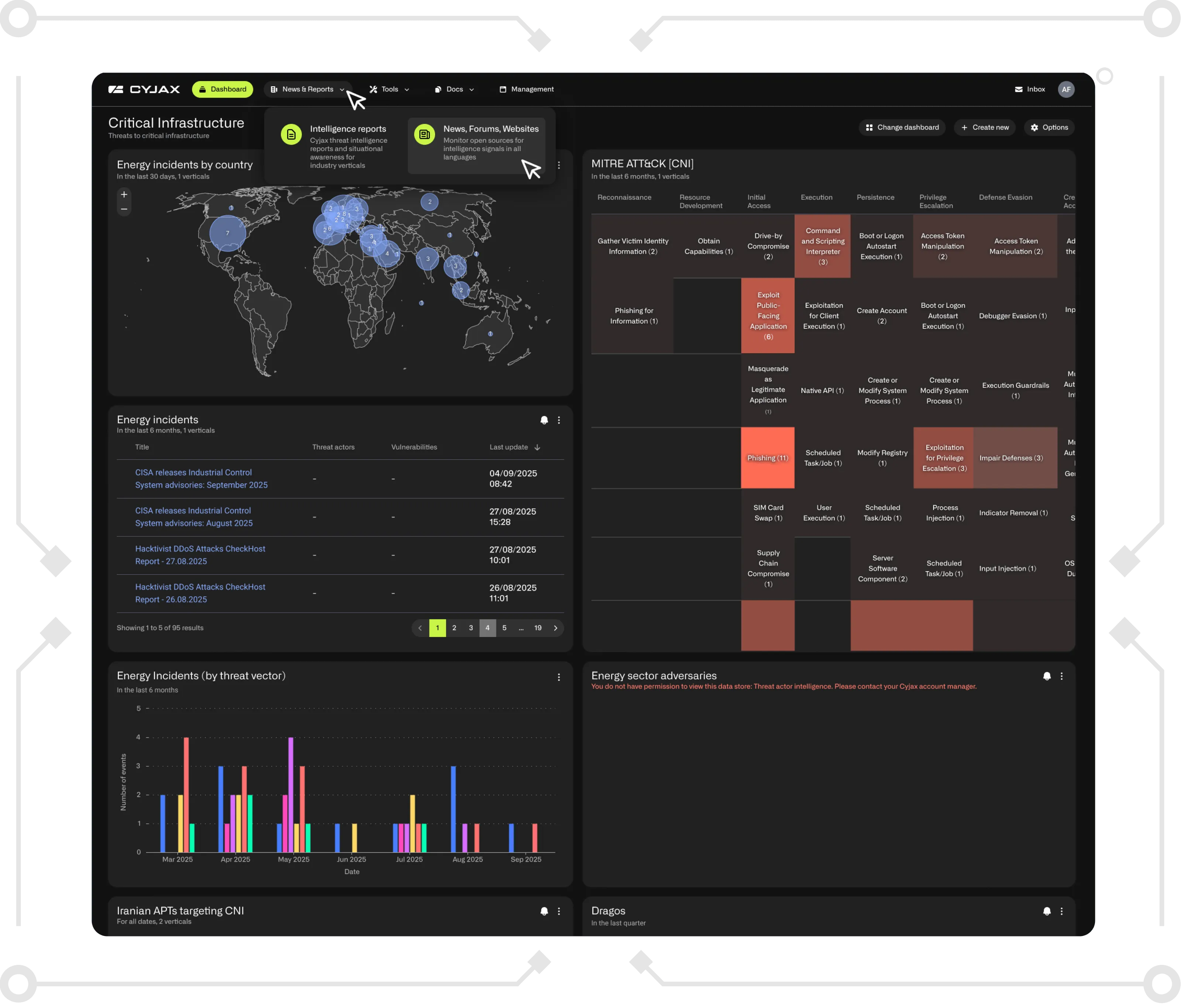
CYJAX combines continuous collection across the open, deep and dark web with a team of experienced analysts who turn raw data into clear, contextualised assessments. That means:
- Intelligence tailored to you, filtered against your brands, domains, people and supply chain.
- Analyst-led reporting that explains what happened, who is behind it and what to do next.
- Timely alerting on the findings that put your organisation at immediate risk.
- Tactical to strategic coverage, from IOCs for your SOC to geopolitical insight for your board.
- Security you can verify. CYJAX is a UK-based threat intelligence company certified to ISO 27001:2022, so your data is handled to an internationally recognised standard.
See the difference for yourself
Don't take our word for it. Ask CYJAX the ten questions above and judge us on the answers.
Book a CYJAX demo today and we will show you real, relevant intelligence on the threats facing your organisation and sector. No generic samples, no dashboard tour, just the intelligence your team should already be seeing.
Recommended for you


Get Started with CYJAX CTI
Empower Your Team. Strengthen Your Defences.CYJAX gives you the intelligence advantage: clear, validated insights that let your team act fast without being buried in noise.